Unit of Foot and Ankle
Specialists in the study, diagnosis, and application of surgical techniques for foot surgery.
Inicio › Medical units › Unit of Foot and Ankle › ARTHROSCOPIC SURGERY › Chronic ankle instability
Chronic ankle instability
Chronic ankle instability is a condition caused by ligament injuries.
Up to 20% of patients who have suffered an ankle sprain will eventually develop this complication.
This condition may lead to other associated injuries, such as damage to the articular cartilage (osteochondral lesions), and, over time, can result in premature joint wear or osteoarthritis.
What are the symptoms of chronic ankle instability?
Chronic ankle instability is characterized by one or more of the following symptoms:
- Chronic joint pain, more pronounced during physical activity.
- A sensation of ankle instability or imminent failure.
- Joint swelling or overload.
A correct diagnosis of this condition is essential since, in many cases, it can go unnoticed, leading to significant medium- and long-term consequences for the patient’s quality of life.
At icatpie, we have all the necessary tools to achieve an accurate diagnosis.
First, we conduct a thorough medical history, assessing the symptoms related to ankle instability as well as their impact on the quality of life of our patients.
Next, through physical examination, we evaluate the presence of symptoms such as pain and its location, joint range of motion, laxity, or the presence of deformities in foot alignment.
Finally, we request additional tests based on the results of the clinical examination and diagnostic orientation. The most commonly used tools include weight-bearing X-rays, ultrasound, and magnetic resonance imaging (MRI).
Once we determine the degree of instability and its impact on the patient, we propose the best possible treatment.
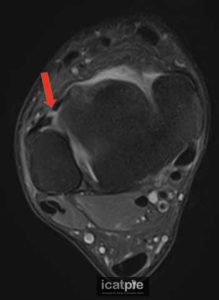
Image: MRI showing an injury to the anterior talofibular fascicle of the lateral ankle ligament.
What treatment is recommended?
After analyzing the tests and making a diagnosis, the initial treatment for most patients is functional rehabilitation (physiotherapy). If symptoms persist after this treatment, surgical intervention may be considered in some cases.
What does surgery for chronic ankle instability involve?
At ICATPIE, the surgical technique we commonly use to treat chronic ankle instability is arthroscopic surgery, although some cases may require open or conventional surgery.
With arthroscopy, we can visualize the ligament injury and repair it. Additionally, we can document associated cartilage injuries (osteochondral lesions), which can also be treated using this minimally invasive technique.
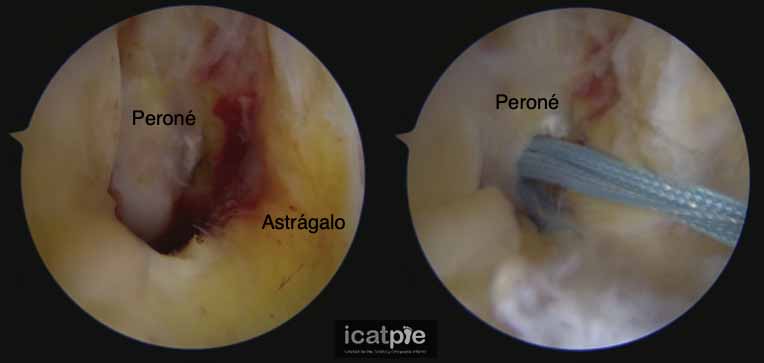
Images showing an anterior ankle arthroscopy to repair chronic instability.
In the left image, the rupture of the anterior talofibular ligament is visible. The ligament, which should connect the fibula to the talus, is absent.
In the right image, we see a detailed moment of the procedure where sutures are passed to repair the torn ligament.