
Bone Reconstruction and Lengthening Unit
Specialists in bone dysplasias, growth disorders, bone malformations, bone lengthening, arthroplasties, lower extremity sports traumatology, and stem cell treatments.
Inicio › Medical units › Bone Reconstruction and Lengthening Unit › BONE LENGTHENING AND CORRECTION OF MALFORMATIONS › Axial Corrections in Congenital Deformities and Traumatological Sequelae
CORRECTION PLANNING
At ICATRECON, the individualized study and follow-up of each patient allows us to confidently propose the most appropriate treatment to correct both the deformity and the limb length discrepancy, with the goal of minimizing surgical interventions. Throughout the growth process, the patient should use the fewest compensatory aids for the shortest possible time, ultimately achieving limb equality at the end of the lower limb’s physiological growth.
TRAUMATOLOGICAL SEQUELAE
- AXIAL DEVIATIONS
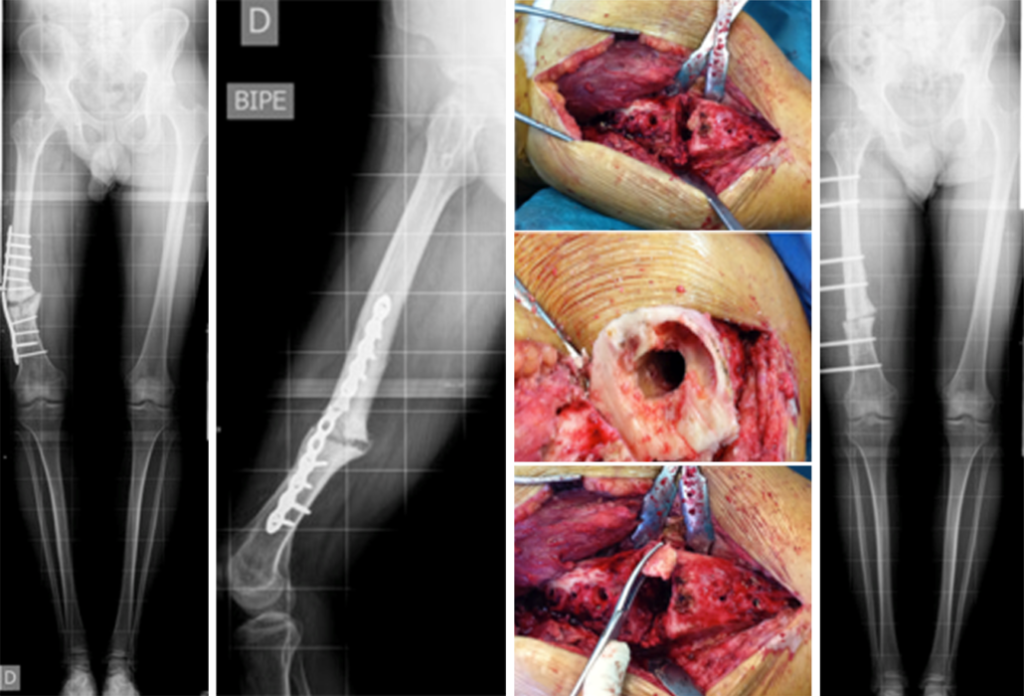
- Case: Nonunion, axial deviation discrepancies.
Focal treatment with bone graft and PRP scaffold, and stem cell concentrate. Compression focus and proximal lengthening.
CONSOLIDATION DELAYS
PSEUDOARTHROSIS
ARTICULAR DEFORMITIES
POST-TRAUMATIC STIFFNESS
BONE AND ARTICULAR INFECTIONS
Bone infections. Osteomyelitis
The complex treatment of bone infections requires close collaboration with the infectious diseases department and the microbiology laboratory.
The ICATRECON team is part of the infection committee of the Hospital to monitor bone infection follow-up and its medical and surgical treatment.
We individualize treatments based on specific protocols that consider both the infection itself and the patient’s overall health conditions.
- We choose the most appropriate combined medical and surgical treatments for each case and patient, aiming to minimize hospital stays and procedure costs, facilitating and promoting outpatient treatments.
BONE DEFECTS
SKIN AND SOFT TISSUE DEFECTS
CONGENITAL AXIAL CORRECTIONS
Most axial deviations of the lower limb bone segments involve a limb length discrepancy.
When dealing with a patient with an axial deviation, it is essential to differentiate whether the patient is an adult with completed growth, a child, or an adolescent with active long bone growth.
ADULTS
- Clinical and radiological study of axial deviation.
- Localization of deviations through alignment tests.
- Measurement of deviations.
- Simulated study of possible corrections and their impact on the final limb length.
- Choice of correction system.
CHILDREN AND YOUTH
- Final discrepancy prognosis. Monitoring of segmental growth.
- Localization of deviations through alignment tests.
- Correction possibilities through temporary physeal arrest.
- Combination of surgical techniques.
- Temporary orthosis adaptation.
SURGICAL TECHNIQUES
Various techniques are used based on age, diagnosis, affected segment(s), discrepancy prognosis, and axial deviation.
LENGTHENINGS
- Monolateral External Fixator.
- Circular External Fixator.
- Mixed External Fixator.
- External Fixator + Intramedullary Nail.
- Auto-Expandable Electronic Intramedullary Nail (FITBONE®).
GROWTH ARREST
- Growth cartilage fusion (epiphysiodesis).
- Complete Temporary Arrest.
- Partial Temporary Arrest.
SHORTENINGS
- In one stage.


