Unit of Foot and Ankle
Specialists in the study, diagnosis, and application of surgical techniques for foot surgery.
Inicio › Medical units › Unit of Foot and Ankle › ACQUIRED DEFORMITIES OF THE FOOT › FLATFOOT VALGUS
FLATFOOT VALGUS

The deformity of valgus flatfoot consists of the flattening of the plantar arch or vault.
The most common cause is an alteration in the function of the posterior tibial tendon and the ligaments that support this plantar arch. The deformity progresses as the damage to the tendon and ligaments causes a decrease in their function until they rupture, resulting in the clinical presentation of complete collapse of the plantar arch.
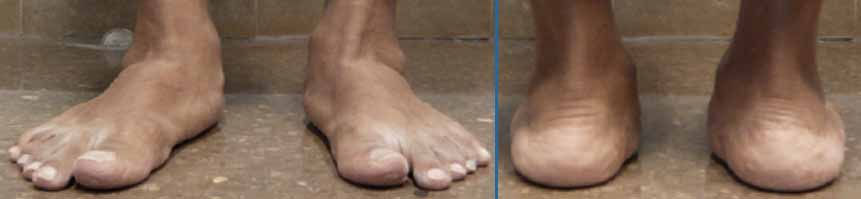
Image: Bilateral flat foot valgus.
What symptoms does the deformity of valgus flatfoot produce?
As previously mentioned, valgus flatfoot is a progressive condition that will cause more or less intense pain when walking or exercising.
In the inner area of the foot, where the posterior tibial tendon and the ligaments of the plantar arch are located, we can identify pain and inflammation.
This pathology is more commonly found in women, especially those of middle age who suffer from overweight, diabetes, or hypertension.
It is important to treat the deformity of valgus flatfoot because it is one of the most frequent causes of injuries and overloads, and it can also lead to other conditions such as plantar fasciitis or hallux valgus (bunions). Moreover, in more severe forms, it can alter the shape of the limb, causing ankle problems or even knee issues.
How is it diagnosed?
Our first step is to gather the patient’s medical history, followed by a thorough physical examination of the feet and ankles.
We will evaluate the strength of the muscles and the patient’s gait pattern to study any possible mechanical issues of the foot.
Next, we will request an X-ray of the feet and ankles while standing, and if necessary, for a more accurate diagnosis, we may resort to other complementary tests such as an MRI or a CT scan.
Once we have identified the degree of the deformity, our team of professionals at ICATPIE will advise the best possible treatment for the patient.
After determining the degree of instability and its impact on the patient, we will plan the most appropriate treatment.

What treatment is recommended?
After studying the tests and making the diagnosis, we may recommend a conservative treatment, which includes the use of orthotic insoles and an appropriate rehabilitation program.
In some cases, we may consider the need for ultrasound-guided injections of Platelet-Rich Plasma (PRP) therapy in the posterior tibial tendon. The purpose of this therapy is to reduce inflammation, alleviate pain, and speed up the recovery of the tendon injury.
In severe cases, the treatment is usually surgical, with the goal of ensuring the proper function of the foot.
What does surgery for the flat foot deformity entail?
The surgical procedure will depend on the degree of deformity, the patient’s age, and whether or not there is arthritis or joint degeneration.
The goal of this intervention, regardless of the technique chosen in each case, will be to restore the alignment of the foot and re-establish the medial arch to ensure proper foot and ankle function.
In many cases, surgical correction of flat foot deformity requires various techniques, both soft tissue and bone-related. Therefore, it may be necessary to combine ligament or tendon repair with bone surgery, such as osteotomy, where the shape and position of the involved bones are modified, or arthrodesis, where one or more damaged joints are fused.
The recovery from this type of surgery tends to be long. Depending on the surgery performed, the patient will need to have the foot in a cast for approximately 6 weeks, and full recovery can take up to a year. For this reason, ICATPIE will only recommend surgical treatment in the most severe cases.
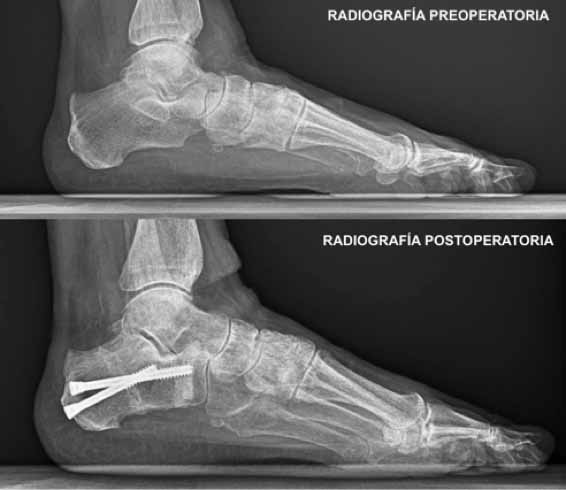
Surgical correction of flat foot deformity through calcaneal osteotomy.