
Unit of Foot and Ankle
Specialists in the study, diagnosis, and application of surgical techniques for foot surgery.
Inicio › Medical units › Unit of Foot and Ankle › ARTHROSCOPIC SURGERY › TENDINOPATHIES
TENDINOPATHIES
Tendinopathies occur when a tendon suffers from overload, leading to an inflammatory process that it cannot recover from. Two types of factors are involved: mechanical (overuse) and biological (lack of repair).
Tendinopathy is the term used to define both tendinitis and tendinosis. While tendinitis involves inflammation of the tendon, tendinosis describes a painful and degenerated tendon due to a series of issues within the tendon tissue itself.
They are more common in people who perform repetitive tasks, either in work or during their sports activities.
Among the possible causes of tendinopathy in the foot and ankle are repetitive microtraumas, physical overload, muscle imbalance, or improper foot posture.
The most common tendinopathies include Achilles tendon involvement and plantar fascia involvement:
This tendinopathy can affect the area where the tendon inserts into the heel (calcaneus), known as insertional tendinopathy, or the segment immediately above it, known as non-insertional tendinopathy.
It is common in runners who increase the intensity or duration of their training or in patients who only engage in occasional sports, typically on weekends.

Magnetic resonance images of a patient with insertional Achilles tendon pathology.
In the photograph on the left, an alteration in the tendon can be seen right at its insertion into the calcaneus. The tendon does not appear homogeneous, with dark areas (healthy tendon) mixed with whitish areas (damaged tendon).
In the photograph on the right, fluid (i.e., inflammation) can be observed between the Achilles tendon and the calcaneus.
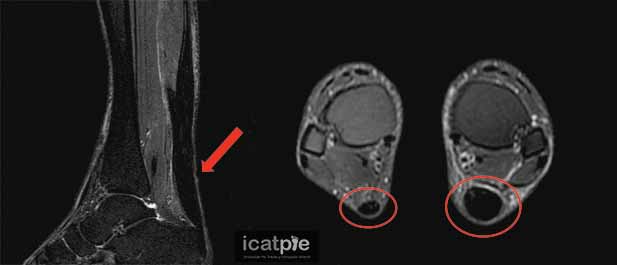
MRI images of a patient with non-insertional Achilles tendon pathology.
In the left image, the Achilles tendon is clearly thickened.
In the right image, the size difference between the healthy tendon (left) and the tendon affected by tendinopathy (right) is visible.
Inflammatory process of the fibrous tissue located in the plantar region of the foot, called the “plantar fascia,” which connects the heel (calcaneus bone) to the toes at the level of the metatarsal heads.
Pain is most commonly localized in the heel, although it can affect the entire sole of the foot. It is frequent in patients who subject this structure to mechanical overload, whether due to inadequate footwear, overweight, or runners.
It is important to remember that the commonly known “heel spur” is a secondary phenomenon to chronic fasciitis, not the cause of the pain.

Left photo: X-ray image of a heel spur, a result of long-term plantar fasciitis.
Right photo: MRI image of the same patient. The spur is visible, as well as irregularity at the insertion of the plantar fascia into the calcaneus, associated with inflammation (whitish areas).
What symptoms do tendinopathies cause?
The symptoms of tendinopathies can appear either gradually or suddenly.
The most common symptoms are:
Achilles Tendinopathy:
- Pain most pronounced after physical activity, which improves with rest.
- Tendon thickening.
Plantar Fasciitis:
- Pain localized in the heel area.
- Pain most pronounced during the first steps upon getting out of bed.
- Worsening pain towards the end of the day.
How is it diagnosed?
Diagnosis is very important in these types of conditions because early treatment helps with the tendon’s early recovery.
At ICATPIE, we place great importance on identifying the stage of the pathology and the mechanism of injury to ensure we treat the problem in the most appropriate way.
We emphasize the importance of understanding the origin of the tendinopathy in order to identify risk factors and prevent it from occurring again in the future.
Therefore, our first step is to conduct a detailed medical history and a thorough physical examination.
Next, we will request the necessary complementary tests, such as radiographs of the foot and ankle in standing position, ultrasound, or MRI, all with the aim of achieving the best possible diagnosis.
Once the type of tendinopathy is identified, our team of professionals at ICATPIE will recommend the most suitable treatment for each patient.
What treatment is recommended?
For these types of conditions, the first line of treatment is always to attempt conservative approaches, which include orthotics (insoles, ankle supports) and an appropriate rehabilitation program.
In some cases, if the severity of the condition warrants it, this treatment can be supplemented with injections, using in some patients biological therapy with Platelet-Rich Plasma (PRP).
The purpose of this therapy is to reduce inflammation, alleviate pain, and accelerate the recovery of the tendinous injury.
In cases of chronic tendinopathy or in elite athletes, if conservative treatment fails, the treatment will shift to a surgical approach.
What does surgery for foot and ankle tendinopathies consist of?
At icatpie, the surgical technique used to treat foot and ankle tendinopathies will vary depending on the specific pathology:
Plantar Fascia:
- Percutaneous release under fluoroscopic guidance: With a minimal incision and under fluoroscopic control, a section of the plantar fascia is performed.
- Proximal release of the medial gastrocnemius: For patients who present with tightness or shortening of the gastrocnemius muscles.
- Minimally invasive endoscopic release: Under endoscopic control, a section of the desired part of the plantar fascia is cut.
Achilles Tendon:
- Open Achilles tendon surgery.
- Tenoscopy of the Achilles tendon.