
Hand, Elbow, and Microsurgery Unit
Specialists in hand, wrist, elbow, microsurgery, minimally invasive surgery, sports medicine, and congenital/child hand conditions.
Inicio › Medical units › Unit of Foot and Ankle › ARTHROSCOPIC SURGERY
ARTHROSCOPIC SURGERY
Arthroscopic surgery is a minimally invasive technique that, thanks to an arthroscope (camera), allows us to operate inside the joint while visualizing the procedure in real-time, without the need to open the joint. This surgery is performed through 2 or 4 incisions of less than 1 cm.
This technique enables us to examine or repair tissues in the ankle (tendons, ligaments, bones, cartilage) and treat conditions that would otherwise be challenging due to limited access. Additionally, it avoids large incisions, reducing wound-related complications typically associated with traditional surgical approaches.
Ankle and foot arthroscopy requires a high level of surgical precision and must be performed by sub-specialized surgeons.
We promote the use of arthroscopy for all foot and ankle conditions that can benefit from this minimally invasive technique.
This approach reduces postoperative pain and recovery time, providing patients with the best therapeutic option to achieve optimal outcomes in each case.
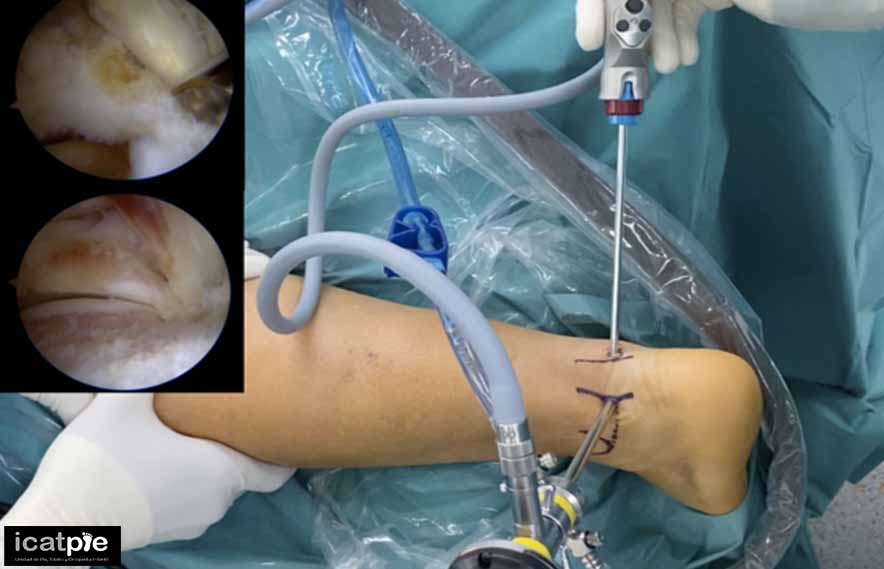
Posterior ankle arthroscopy
The accompanying image shows a moment during surgery. Markings for the portals are visible, ensuring no damage to critical structures such as the Achilles tendon or sural nerve. On the left, we see the surgeon’s view on a monitor during the arthroscopy.
Conditions Treatable with Arthroscopy:
- Chronic ankle instability
- Osteochondral lesions
- Tendinopathies
- Assistance in trauma-related conditions, whether to improve reduction in acute fractures or to resolve complications such as joint stiffness
- Joint fusion surgery (arthrodesis)
- Other conditions, such as posterior ankle impingement, anterior or posterior ankle “impingement”.
Anterior ankle arthroscopy
On the left, we observe the most critical step in preparing for arthroscopy: marking the portals, identifying the safest areas to insert the camera and instruments to avoid damaging critical structures like tendons or nerves. On the right, we see a moment during surgery. The camera is inserted through the rightmost portal, while instruments are introduced through the left portal to operate inside the ankle joint.
Chronic ankle instability is a condition caused by a ligament injury.
Osteochondral lesions are joint injuries affecting a portion of cartilage and subchondral bone (bone beneath the cartilage) surrounded by healthy tissue. These injuries frequently affect the ankle, disrupting the normal function of the joint.
The Achilles tendon is responsible for transmitting the contraction force of the gastrocnemius (internal and external) and soleus muscles.
Tendinopathies occur when a tendon suffers from overuse, triggering an inflammatory process from which it cannot recover. Two types of factors contribute to this condition: mechanical (overuse) and biological (lack of repair).


