Hip Unit
Established alongside the creation of the Department of Locomotor System Pathology and Sports Medicine.
Inicio › Medical units › Hip Unit › Hip Osteoarthritis
What is Hip Osteoarthritis?
Hip osteoarthritis is a condition affecting a large number of people worldwide. Its incidence in the population varies greatly depending on race. It is much more common in the white race compared to the Asian race, ranging from 3% to 6% of the population in our Western world, depending on the country. In the United States alone, 30 million people suffer from it. To give an idea of the healthcare costs associated with this, it results in 557,000 surgical interventions per year. In Spain, approximately two million people will suffer from hip-related problems during their lifetime. According to data provided by the authorities, the total number of hip replacement surgeries, both partial and total, and revision surgeries, varied from 60 to 200 per 100,000 inhabitants per year in OECD countries by the end of the 1990s. This highlights the significance and scale of this condition.
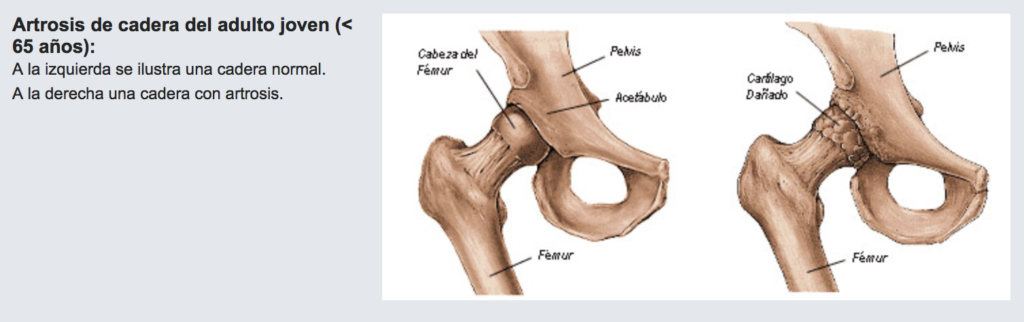
Like other weight-bearing joints in the human body, the hips are at risk of osteoarthritis, which involves the wear and tear of the part responsible for providing proper sliding and cushioning between the femoral head and the coxal bone’s cup that holds it, known as the acetabulum. This layer responsible for this function is called “articular cartilage.”
The articular cartilage covers the femoral head and the acetabulum, facilitating the movement of the entire joint. However, when it wears down, it causes a series of symptoms. The first sign may be discomfort and stiffness in the groin upon waking up, standing up from a chair after sitting for a prolonged period, getting out of a car, or even sitting for an extended period. The pain will increase with movement and improve with rest. For example, it is common to experience pain and difficulty when putting on shoes.
If this condition is not treated in time, it worsens to the point where even rest does not alleviate the pain. The hip loses more and more mobility, and even lower back pain may appear, as an unconscious attempt by the individual to compensate for the hip’s limited movement with increased movement of the spine. At the end of this wear process, the bones begin to rub against each other, causing severe pain with any movement. A limp becomes more pronounced due to the hip, and, worse, the muscles weaken.
The risk of developing hip osteoarthritis increases if there is a family history of the condition, especially as a result of certain congenital deformities, some of which are known as “dysplasias.” Other diseases that affect both the quality and future shape of the joint, appearing in childhood or adulthood, can also cause hip osteoarthritis over the years. It is also obvious that obesity, prior accidents, and old age (there is an easy rule to remember: at 80 years old, 80% of people show some degree of hip osteoarthritis) are other significant factors. However, it is not necessary to suffer from any of these conditions to develop hip osteoarthritis. This is known as idiopathic osteoarthritis.
Treatment of hip osteoarthritis in young adults
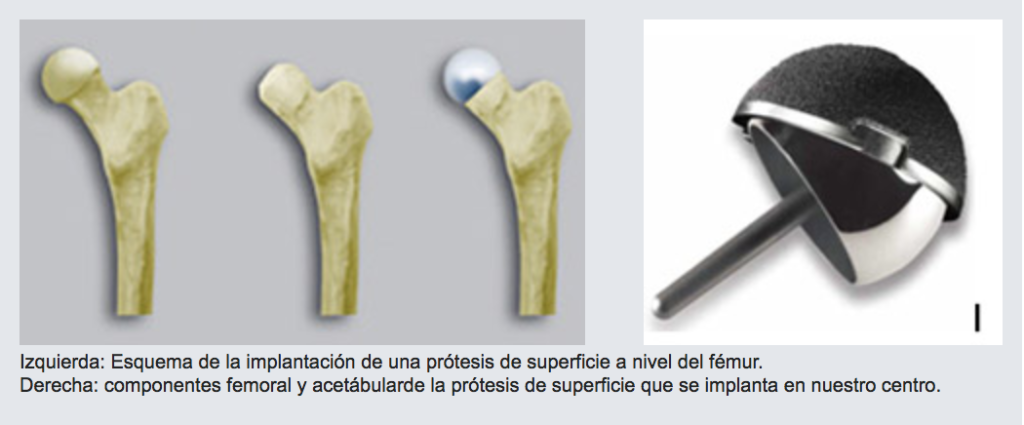
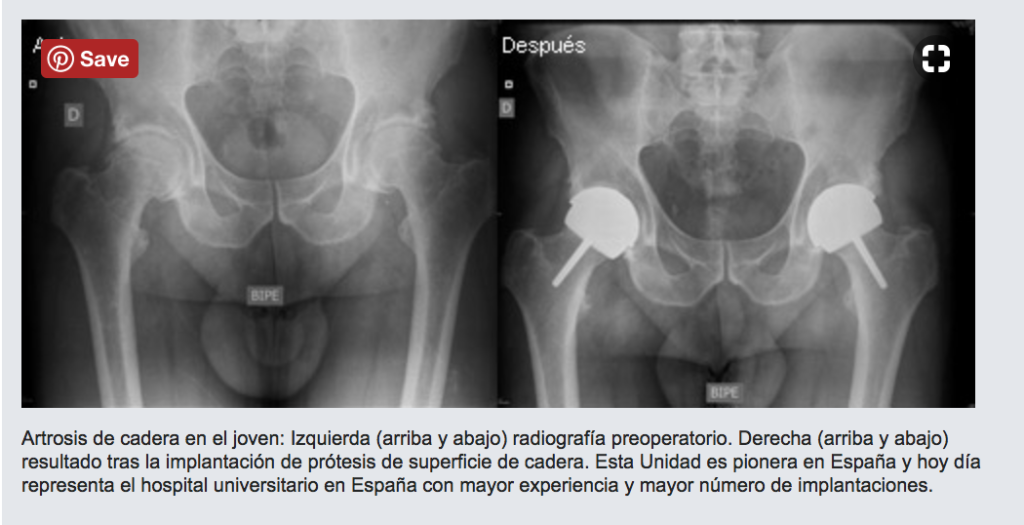
When hip osteoarthritis is fully established in a young adult, it should not be a sentence to give up a good quality of life, including the practice of physical activities and sports. Modern developments from the 1990s in prosthetic implants that only cover the joint surfaces have provided unprecedented success in the surgery of osteoarthritis in this age group. In Spain, the IUD has been a pioneering center in this treatment. It is known as “surface replacement” (in English, “hip resurfacing”).
This prosthesis avoids cutting the femoral neck and only adapts the femoral head by covering it with a metal coating that articulates with a metal cup in the acetabulum. Its durability is very high, exceeding 95% at 10 years. Our service is the university hospital with the most experience in surface prosthesis implantation in Spain, with nearly 1,000 prostheses implanted, and the third center in Europe by the number of surface prostheses implanted.
Furthermore, it is important to note that in the life of a young adult, this prosthesis never closes the door to the implantation of a total hip prosthesis in the future if needed.